PeachTree Music Group

Showing posts with label Antonio TopcaT Randolph Big-N-Mage Publishing. Show all posts

Thursday, March 19, 2026

From 2018 - 2026 "The New Standard for Digital Performance"

Copyright Royalty Board 2026 Rate Determination: The New Standard for Digital Performance


By 7opca7 | March 19, 2026

The Copyright Royalty Board (CRB) has finalized the 2026 cost-of-living adjustments (COLA) for master recording copyright holders and non-commercial webcasters. These updates reflect the final phase of the Web V rate period and account for the inflationary pressures that have reshaped the music economy since the landmark 2017 determinations.

Streaming Rate Comparison: 2018 vs. 2026

The CRB continues to adjust rates based on the Consumer Price Index (CPI), resulting in a steady climb for per-performance royalties.

Service Type2018 Rate2026 Rate (Projected/Set)
Commercial Subscription$0.0023$0.0032
Commercial Ad-Supported$0.0018$0.0026

The Difference: In 2018, the industry saw a modest "basis point" increase. By 2026, the cumulative impact of inflation and the transition from the Web IV to the Web V era has pushed subscription rates up by nearly 39% compared to eight years ago. This shift reflects the CRB’s commitment to ensuring that master recording owners, labels and independent artists, keep pace with the rising costs of digital infrastructure and living expenses.

Non-Commercial Webcasters

For 2026, non-commercial webcasters will pay $0.0026 per performance for all transmissions in excess of 159,140 aggregate tuning hours (ATH) per month.

  • Then (2018): The rate was $0.0018.

  • Now (2026): The rate has matched the commercial ad supported tier, closing the gap that existed in the late 2010s and simplifying the royalty landscape for mid to large non commercial stations.

Mechanicals and Sirius-XM

While your original article anticipated a "slate of determinations," 2026 finds the industry operating under the matured Phonorecords IV agreement.

  • Mechanical Royalties: Songwriters and publishers are now benefiting from a headline rate of 15.35% of total service revenue, a significant jump from the 11.4% rate that was being fought for in late 2017.

  • Satellite Radio: SiriusXM and Music Choice rates, which were once negotiated in isolation, are now more closely aligned with the "willing buyer/willing seller" standard, significantly increasing the payout to SoundExchange for featured artists.

Satellite Television Retransmission

Beyond music, the 2% COLA mentioned in 2017 has evolved into a more aggressive adjustment period.

  • Private Home Viewers: The rate has risen from the 2018 mark of 28 cents to 34 cents per subscriber per month.

  • Commercial Establishments: The rate for commercial viewers has climbed from 58 cents to 71 cents per subscriber per month.

The 2026 Perspective

In 2017, the industry was focused on "basis points." In 2026, the conversation has shifted toward Total Royalty Optimization. With the integration of AI-tracking and blockchain based distribution (technologies Mr. Randolph and firms like Big-N-Mage are currently championing), the accuracy of these collections is higher than ever before. While the rates have increased, the primary challenge in 2026 remains the "metadata gap" ensuring that these higher rates actually reach the pockets of the correct rights holders.


Thursday, January 30, 2025

Spotify is now going to pay a higher royalty rate to Universal Music Publishing Group


The news broke this past Sunday that Universal Music Group and Spotify have struck a new, multi-year licensing deal.

+Read this (and comment) on aristake.com

+Share this on Instagram @aristake_

The main takeaway is that Spotify is now going to pay a higher royalty rate to Universal Music Publishing Group for mechanical royalties. Theoretically higher than Spotify is going to pay any other songwriter or publisher.

Let’s back up and put this all into context.

When Spotify initially launched way back in 2008, the music industry was in a death spiral. CD sales were plummeting. iTunes sales were not making much of a dent in the piracy ravaging the industry. Spotify, it seemed, could present a legal alternative to the piracy and a pathway to recovery. However, Spotify needed the major labels to gain access to the most popular music in the world to power the platform.

The major labels licensed their full catalogs to Spotify, but made sure the agreements were on their terms and that they made out just fine no matter what. Spotify paid the majors massive advances (with no requirement that any of that money trickle down to their artists). The majors got equity in Spotify (collectively around 18% - which is now below 7% after cashing out shares in the hundreds of millions of dollars), lots of kick-backs in the form of free advertising on the platform, and most egregious of all, higher royalty rates than indie labels and artists got.

The big myth of the streaming era is that all streams are created equally.

Even though per-stream pay has been estimated, there is no such thing as a per-stream rate. And even though a simplified explanation of how streaming currently pays via the pro-rata model that Spotify utilizes, goes something like: artists & labels make the proportionate amount of money equal to the proportionate amount of streams they get versus all other streams on the platform. It’s not even that simple.

This payment model also establishes the variance of payments by explaining that streams that come from paid subscribers will pay more than streams that come from free users. And streams from users on cheaper plans (like family plans, or in countries with a lower subscription cost) also earn less.

But even all that isn’t the full truth.

See, one UMG stream is going to earn more than one indie artist stream. From the identical listener. Why? Because every label and distributor negotiates their rates directly with Spotify. And with strict NDAs included in every licensing deal, we may never know what these rates are and which label or distributor gets paid the most.

But you better believe that UMG is going to make damn sure that they get the highest rates in the industry.

Just like they did with Sunday’s deal.

Now when it comes to publishing, however, the majority of the royalties are based on a transparent statutory rate (set by the US Copyright Royalty Board), and paid out via the government-mandated collection organization, the MLC (for mechanical royalties). And the other publishing royalties are paid out via Performing Rights Orgs like ASCAP, BMI, SESAC, GMR (for performance royalties). And then these orgs pay songwriters and publishers.

However, some publishers can opt out of these compulsory agreements and strike direct deals with Spotify and other DSPs.

Which UMG just did.

Spotify took a lot of flack last year for announcing it was going to be paying publishers and songwriters an estimated $150 million less in royalties in just the first year because it was reclassifying its premium subscriptions as a “bundle” since adding audiobooks. Thanks to a celebrated agreement between the NMPA (the organization representing publishers) and DiMA (the org representing streamers), the mechanical royalty rate is reduced for bundled tiers. (The MLC sued Spotify over this, stipulating that this bundle reclassification was “unlawful,” but just lost that case.)

UMG has now skirted this loophole that Spotify exploited.

In the press release, UMG CEO Lucian Grainge stated, “This agreement furthers and broadens the collaboration with Spotify for both our labels and music publisher, advancing artist-centric principles to drive greater monetization for artists and songwriters, as well as enhancing product offerings for consumers.”

He continues to push this “artist-centric” doublespeak that he coined a couple years ago while laying the groundwork for indie artist theft. There is absolutely nothing artist-centric about any of the initiatives UMG has pushed onto the industry recently.

WIthholding pay from poorer artists to give to richer artists isn’t artist-centric. Penalizing indie artists when their songs get botted, isn’t artist-centric. Striking deals with generative AI music companies that flood Spotify with AI generated music, pulling royalties away from human artists and songwriters, is not artist-centric.

We can safely assume that anything UMG states as “artist-centric” is in actuality, label-centric. Or more aptly, UMG-centric.

And now, Spotify is attempting to overshadow this clear royalty manipulation in favor of the largest music corporation in the world valued at over $50 billion, by announcing it paid the music industry $10 billion in 2024.

In the press release, it also states “Today, well over 10,000 artists generate over $100,000 per year from Spotify alone. That's a beautiful thing.”

But now we know we can’t take anything Spotify says at face value. As revealed in immense detail in Liz Pelly’s new book Mood Machine (and initially excerpted in her Harper’s piece), Spotify has been filling its extremely popular official editorial playlists with low-cost, royalty-free music from stock-music companies (sometimes AI-generated), with the goal of paying fewer royalties to working artists: intentionally replacing real artists on these high-trafficked playlists with “ghost” artists that don’t actually exist.

This makes Spotify’s stock price go up, all while artist pay goes down.

I get it. We live in a capitalist society. And Spotify and UMG are beholden to their shareholders. Their goal is to make more money at any cost. Artists be damned.

But when the CEO of the largest music streaming platform in the world is worth more than the 4 richest musicians combined, all while continually undercutting the hard-working musicians and songwriters that power his platform, it’s time we stop pretending the game is fair.

So, what are we to do?

Taking your music off of Spotify ain’t a realistic solution when that’s how the majority of the listening public prefer to listen to music (and without a coordinated effort from every artist - many of whom are beholden to their labels - it won’t move the needle).

Not to mention, Spotify is the only DSP actively promoting concerts (with ticket links) and offering commission-free merch. I will absolutely give credit where credit is due.

Apple Music, TIDAL, and Amazon Music are also owned by billionaires and similarly pay on the same pro-rata payment model. People mistakenly claim that “TIDAL pays more!” or “Amazon Music pays the most!” This is not true.

There isn’t an artist on planet earth that has made more money from TIDAL or Amazon Music than from Spotify.

The only reason their “per stream rate” (which, remember, ISN’T A THING) is because they have so few users.

Would you rather make more of less or less of more?

Government intervention seems to be the only way to make the streaming landscape fair. To require that every stream is treated equally. Make direct licensing illegal. Undo the licensing NDAs so we have transparency.

Even though there was a bill introduced to the US House last year, The Living Wage For Musicians Act, (thanks to immense advocacy work by the UMAW), which has some great stuff in it, it hasn’t moved past the introduction stage. And seems unlikely it will.

I think we can advocate for a more fair music industry, while simultaneously, as Talib Kweli recently put it in his interview on The Daily Show, “build industry around yourself.”

The only way to cut out the from corporations and take matters into our own hands is to go direct to the fans.

Instead of renting our fans from social media and streaming platforms, we need to own them. Get your fans’ emails and phone numbers. Create a community with your fans via the many services out there like Vault.fmMySeatOpenstagePatreonBandcamp, or EVEN.

The majors have always rigged the game since the beginning of time. We can’t expect them to change in our capitalistic society. But we can find a better way forward as musicians. Together.

~Ari
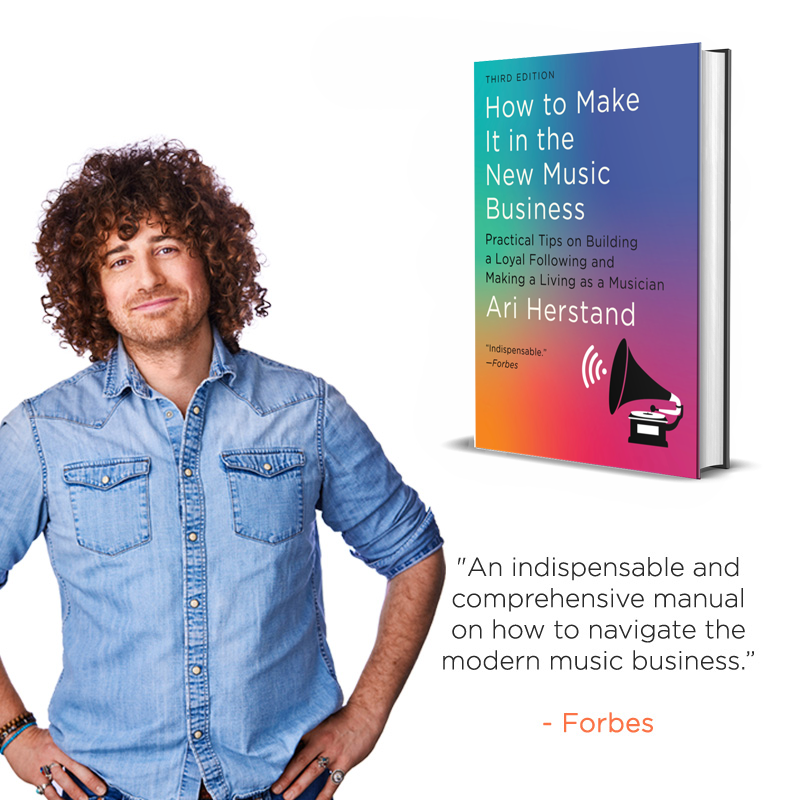
Ari Herstand and his book, How to Make It in the New Music Business, Third Edition

Follow Ari's Take on Instagram @aristake_ and TikTok @aris.take for daily doses of inspiration.

Subscribe on YouTube @aristake

Subscribe to the The New Music Business Podcast

+Who is Ari?

Visit: https://aristake.com

My music:
ariherstand.com

Sign up for the email list


Thursday, May 16, 2024

đźš« Sony opts out of Gen AI firms using its music

Sony Music sends letters to 700 AI, music streaming companies declaring it's 'opting out' of AI training Sony Music Group (SMG) is in the process of sending out letters to 700 AI developers and music streaming services, declaring that it is “opting out” of having its content used in the training of AI. Also, any AI developer who wants to use SMG’s content will need explicit permission. The letter, obtained by MBW, also states that these companies may have already violated Sony Music’s copyrights. “Due to the nature of your operations and published information about your AI systems, we have reason to believe that you and/or your affiliates may already have made unauthorized uses (including TDM [text and data mining]) of SMG Content in relation to the training, development or commercialization of AI systems,” states the letter. The letter goes on to ask the companies in question “to undertake that neither you nor any of your affiliates have made any such unauthorized uses,” or to provide information on any SMG-owned content used “to train, develop or commercialize any of your AI systems..." Sony has not disclosed which 700 companies it is sending the letter to... (MBW Explains) MAY 16, 2024BY DANIEL TENCER MBW Explains is a series of analytical features in which we explore the context behind major music industry talking points – and suggest what might happen next. Only MBW+ subscribers have unlimited access to these articles. WHAT’S HAPPENED? Sony Music Group (SMG) is in the process of sending out letters to what MBW understands to be 700 AI developers and music streaming services, declaring that it is “opting out” of having its content used in the training of AI. Also, any AI developer who wants to use SMG’s content will need explicit permission. The letter, obtained by MBW, also states that these companies may have already violated Sony Music’s copyrights. “Due to the nature of your operations and published information about your AI systems, we have reason to believe that you and/or your affiliates may already have made unauthorized uses (including TDM [text and data mining]) of SMG Content in relation to the training, development or commercialization of AI systems,” states the letter. The letter goes on to ask the companies in question “to undertake that neither you nor any of your affiliates have made any such unauthorized uses,” or to provide information on any SMG-owned content used “to train, develop or commercialize any of your AI systems,” and a “description of the manner in which such SMG Content was accessed and/or reproduced and/or extracted by you or your affiliates or any third party contracted to do so on your behalf.” Sony has not disclosed which 700 companies it is sending the letter to. In a public declaration published on the websites of Sony Music Entertainment and Sony Music Publishing on Thursday (May 16), SMG said that it and its affiliated companies “expressly prohibit and opt out of any text or data mining, web scraping or similar reproductions” except “as specifically and explicitly authorized by either SME or SMP.” That includes “musical compositions, lyrics, audio recordings, audiovisual recordings, artwork, images, data, etc.” for any purpose including “training, developing or commercializing any Al system.” The letter makes it clear that AI developers who wish to train their technology on Sony’s IP will have to clear it with the company in advance. On top of AI developers, MBW understands that Sony’s letter is being sent to music streaming services in the hopes that they take action to prevent AI developers from scraping their libraries for Sony-owned content. The company is reportedly in talks with streaming platforms to have them update their terms of service to forbid the mining and scraping of their content. The letter indicates that the opt-out declaration and the request to AI developers to disclose the materials they used in training their AI is a reaction to the European Union’s recently-passed AI Act. Among other things, the EU AI Act requires developers of “general purpose AI” technology to keep track of and publicly disclose the materials they used in training their AI models. (Some legal experts have argued that it isn’t clear what does and doesn’t qualify as a “general purpose AI.”) The AI Act also includes a principle brought in from the EU’s 2019 Copyright Directive, which requires AI developers to get permission to use copyrighted materials in their AI technology, if those copyright holders have opted out. The idea of an “opt-out” clause for copyright holders has been opposed by some music industry groups, who argue that the principle should be one of “opt in” – the law should assume that copyrighted material can’t be used to train AI, unless the copyright owner grants permission. “Opt-out regimes fundamentally undermine copyright protections by shifting the burden to obtain a license away from users,” the US National Music Publishers Association (NMPA) said in a submission to the US Copyright Office in 2023. “An opt-out scheme that requires rights holders to opt out on an AI company-by-AI company or application-by-application basis would not be feasible, given the sheer volume of AI companies and applications; it is nearly a full-time job to keep up with developments in the AI marketplace… Copyright owners, particularly individual creators and small businesses could not possibly meet such a burden.” WHAT’S THE CONTEXT? Sony’s mass mail-out to AI developers highlights the company’s somewhat unique approach to tackling the issue of AI, one that at times stands in contrast to other music companies. For instance, Sony was the only one of the three major global recording companies not to participate in YouTube’s Dream Track experiment, a project to develop YouTube Shorts using AI technology. Nonetheless, the company is not shying away from AI altogether. Last summer, Sony Music Entertainment hired its first-ever Executive Vice President for Artificial Intelligence, Geoff Taylor. And last November, it unveiled a project from electronica act The Orb and David Gilmour of Pink Floyd, which involved the release of Metallic Spheres in Colour, an interactive remake of their 2010 album Metallic Spheres that allowed fans to remix the music on the album using AI tools. At a forum on artificial intelligence in the US Senate last fall, SME’s President of Global Digital Business and US Sales, Dennis Kooker, noted that SME had issued some 10,000 individual takedown notices to various platforms against AI-generated deepfakes “that SME artists had asked us to take down.” Kooker also opposed the view expressed by some AI developers, including Google, that using copyrighted material to train AI models should fall under the “fair use” exemption to copyright law. If that principle were to be accepted, it would mean that “certain companies are permitted to appropriate the entire value produced by the creative sector without permission, and to build huge businesses based on it without paying anything to the creators concerned,” Kooker said. The complete text of Sony Music Group’s public declaration is below. SONY MUSIC GROUP – DECLARATION OF AI TRAINING OPT OUT Sony Music Group (SMG) and its affiliates have invested in the development and promotion of songwriters and recording artists all over the world for more than a century. SMG is a passionate believer in the inherent and paramount value of human artistry. Additionally, SMG has been embracing the potential for responsibly produced Al to be used as a creative tool, revolutionizing the ways songwriters and recording artists create music. We support artists and songwriters taking the lead in embracing new technologies in support of their art. Evolutions in technology have frequently shifted the course of creative industries. Al will likely continue that long-standing trend. However, that innovation must ensure that songwriters’ and recording artists’ rights, including copyrights, are respected. For that reason, SMG’s affiliates, Sony Music Publishing (SMP) and Sony Music Entertainment (SME), on behalf of themselves and their wholly owned or controlled affiliates, are making this affirmative, public declaration confirming that, except as specifically and explicitly authorized by either SME or SMP, as the case may be, each of them expressly prohibits and opts out of any text or data mining, web scraping or similar reproductions, extractions or uses (“TDM”) of any SME and/or SMP content (including, without limitation, musical compositions, lyrics, audio recordings, audiovisual recordings, artwork, images, data, etc.) for any purposes, including in relation to training, developing or commercializing any Al system, and by any means, including by bots, scrapers or other automated processes, in each case to the full extent permitted by applicable law in all relevant jurisdictions. This declaration reaffirms and is without prejudice to all of SMP’s and/or SME’s prior rights reservations and their respective legal rights, all of which are expressly reserved. SME’s and SMP’s rights reservations apply to all existing and future SME and SMP content, including those creative works that may be identified through publicly available means or listed from time to time in databases such as those maintained by the International Federation of the Phonographic Industry (IFPI) and the [International Confederation of Music Publishers (ICMP).] Music Business Worldwide

Friday, April 14, 2023

Benj! feat. iSupa Dave - GRADUATE

https://dap.direct/d2/share/eyJzIjozMTE2NjB9 https://dap.direct/d2/share/eyJzIjozNDE4MDl9
antoniotopcat@gmail.com

Sunday, November 4, 2018

Spotify playlist pitching review of Playlist Push


First want to give a quick shoutout to Ari's Take partner AWAL. They have a helpful blog post on when you get included on a Spotify playlist, how to make sure you don't get bumped off of it. Check it out here. 
Also, as a reminder, enrollment for Ari's Take Academy: How To Become a Successful Touring Artist closes Tuesday! Join us. 
I got an email from a long-time reader and very talented artist, Jessica Lá Rel who shared her experience with Playlist Push and had some very understandable concerns. 
But first, I want to update you on Playlist Push since my first report came out a few weeks back. For those of you just getting caught up to speed, I’ve been digging into all things Spotify the past couple years. Specifically, how to get included in playlists. I reviewed SubmitHub, which proved to be somewhat helpful at getting (small) blog coverage, but the playlists on the service were totally fake with no real engagement. I pointed this out in my review and since then, they completely changed the way they accept and rate the playlists you can submit to on the service. Props to SubmitHub for taking it seriously and changing course! 
I also wrote about how my album got removed for using a service I thought was a legit playlist pitching company, but was in fact using bots to increase streams (in addition to getting the song included on some playlists). 
I’ve spoken to many streaming experts ranging from owners of playlist pitching companies to big time distributors with playlist pitching departments to labels to managers to marketing agencies to Spotify employees. The biggest takeaways are that it’s the Wild Wild West out here in the digital streaming world and that what is true today may not be tomorrow. 
This all being said, after extensively looking into Playlist Push (testing two very different songs on the platform), interviewing the founder and a couple managers and artists who have used the service, I determined it was one of the few legitimate services out there to pitch your songs to user generated playlists. 
That being said, it is flawed. But the founder George knows they have work to do and are actively working to improve their service (and are listening to all the critiques and constructive criticism I’m tossing their way). After I posted my review, I became a “curator” on Playlist Push for my Low Volume Funk playlist so I could see it from the OTHER side of the equation. I have since updated the review to reveal my findings. 
To catch you up - as a curator of a 2,550 follower playlist (with about 400/monthly listeners) - it's not really a money-making venture unless you're doing SERIOUS volume. Currently I'm making $2/song. Considering I (or my team) listen to each song in its entirety and then try to write a thoughtful review, it's not really worth the time for me. But I understand other curators probably have more time or only listen to a snippet of the song and write short reviews. And as a curator grows within the platform they could be earning up to $20/song if their playlist is gigantic (500,000 followers or so). But, again, most are probably around the $2-$5/song mark.
The biggest frustration I’ve noticed having been a curator on the platform for just over a week is that most of the songs I’m being sent aren’t remotely close to the songs on my playlist. I selected the genres “Funk” “Soul” and “R&B” and the songs on the playlist all have organic instruments - not created ‘in-the-box.’ Most of the songs submitted to me, however, are hip hop or pop songs that are fully electronic (no real instruments). So, if an artist selects the “Soul,” “R&B” or “Funk” genres, I’ll get sent the song. I really wish there was a better genre selection tool that only sent songs that would actually fit on the playlist. I feel bad that these artists are wasting their money sending the songs to me. Some of the songs are great! They just don’t fit on the playlist. 
At least on SubmitHub, you can personally pick the playlists you’re submitting to. With this, you have to just trust that Playlist Push will send your songs to the appropriate curators. The founder, George, and I had a call today where I expressed this frustration (after passing along the below email from Jessica) and he did mention that they have a totally new genre selection process rolling out very soon. I’ll update the review once that is fully implemented.
Jessica’s email: 
I wanted to reach out to share with you a recent experience I’ve had. I’ve been following you for a long time. Back in the early days of Ari’s Take, to the webinars, the book, the online course, the live full day panel events, etc. I’ve considered you one of the most genuine voices I’ve come across in the industry thus far. I‘m loyal; I preach the gospel of Ari Herstand to other creatives. I buy your various packages and have been a subscriber for over 5 years now. I trust your feedback and insight not just because you do your homework and have lived experience, but also because you have built a brand around trust by providing resources to independent artists all over. You have focused on those that often get neglected or taken advantage of in such a brutal industry.
But recently I had an experience that brought me to a crossroads with that trust. I usually don’t write emails this long, so I apologize in advance for the length.
I had some difficulty using the new Spotify For Artists feature when they first announced their beta product in July. I released 2 eps and a culminating album between May and October. So it was nice to hear your perspective on ways to approach Spotify playlists beyond the beta feature. After reading your review of Playlist Push, I checked them out. The approach made sense to me: genre based outreach and a genre/playlist potential based payout structure. I spoke with customer service throughout the process to determine which kinds of campaigns to set up. I had previously conducted a survey with fans to determine which songs would make for the best Spotify playlist campaigns. So I set up 3 campaigns. 1 for a song on the 2nd EP that would run until the release of the album. And then the last two to run concurrently as soon as the album dropped. 
The first campaign for a song called Home Above Water did not perform well via Playlist Push. At first, I just took it as a sign that the music wasn’t there yet. But then I looked at the reviews of the song and realized that there was a major problem. The song was registered as Soul, but the reviews were coming from folks who curate lists for “depressing hip hop”, EDM, electro pop, Reggae, etc. Everyone kept saying “it doesn’t fit this kind of playlist”, and I’m thinking, “of course! This song is definitely not EDM, hip hop, pop or reggae. Think Eryn Allen Kane, Chance the Rapper’s more inspirational songs/Donnie Trumpet and the Social Experiment, Grace Weber, etc.
I spoke with customer service about it. They seemed to understand. I requested to cancel the upcoming campaigns and get a refund for the first. Steve then offered to do one more campaign, and if it also doesn’t satisfy me then he would refund me for all three campaigns. He offered a full refund on all three songs. I was hesitant to continue, but he insisted that the next song would have more options because it fit R&B and Soul. So together there would be more targeted playlists to submit to.
Within the first day, the second song Lighthouse landed on a Reggaeton playlist. So I knew I was heading down the same road. I reached out the second day of the campaign but didn’t hear anything for 1.5 weeks. By that time, it had been placed on 5 playlists: Reggaeton, Boy Bands, Hip Hop, a pop playlist, and finally your Low Volume Funk playlist. So at this point of the 5 playlists, the one that comes remotely close to my actual genre is curated by the same person who encouraged me to check out the platform in the first place. I felt debilitated in a number of ways. 
In the end, I argued quite a bit with customer service. They reneged on their refund offer, claimed a full refund from them was not possible and was unfair, and that no one complains about getting on 5 playlists. I tried to explain to them that it’s not about the quantity of playlists or listeners but the quality of listeners. Getting on a reggae playlist does not help me get my music to fans and potential fans where they actually are. If anything, it makes them less prone to engage with my music because they are listening to a reggae playlist with the intent of listening to actual reggae, not cinematic soul. Everything I do is in an effort to reach potential superfans.
I ended up walking away with a partial refund and plenty of condescending remarks from Steve... but more than that I lost a lot of trust. In an industry with little mentorship for independent artists, you were the closest thing to a reliable resource I had, and to find out that the agency you recommended was pretty much a scam (like the others you discuss in the blog) that would take my money and throw my music at any Playlist that bites- and then to find out that you’re getting paid on both ends (for referring them and then for curating), didn’t necessarily help. 

So first off, I want to give Jessica major props for sending me this very heartfelt email. And for being so candid. Not everyone speaks up when they are experiencing frustrations or roadblocks, but the only way to make things better is by approaching them head on. I know it must have been frustrating to spend a good amount of money on a campaign and then be disappointed by it. I've done it time and time and time again. I'm sure you have too. 
I want to hear your successes and your pitfalls. All of them. The good, the bad, the ugly. We’re all in this crazy industry together! And I am a student first. I want to learn so I can teach. Nothing brings me more joy than being able to pass along valuable information that I learn and to see you use it successfully. 
I do want to be perfectly clear about my involvement with Playlist Push (and any company I review). I never accept an affiliate code or advertising partnership until AFTER I write my review so my review is completely unbiased. I never let the companies read my review before it’s posted. And I only accept affiliate codes or ad partnerships with companies I believe in. Some companies I reviewed negatively have attempted to throw money at me to change my review. But I turn them down at every corner because all I have is my reputation and the trust I have built with the community.
No, I cannot be bought off. I will not take money from companies or people I don’t believe in.
After my extensive review of Playlist Push, it seems like a valuable service. I stand by it (today). Will that ever change? Maybe. But like any ad partner I’ve ever had, when I get complaints from readers I take them immediately straight to the top. If they aren’t resolved to our satisfaction immediately, I end our relationship and I write about what happened. However, the good ones out there take their customer complaints very seriously and resolve the issues quickly. 
I understand the responsibility I have being one of the few working artists out there with so much access to people in the industry and I take this responsibility very seriously. I’m always looking out for artists and I answer to no one but you. 
Whatever you’re experiencing, the good, the bad and the inspirational. Lemme hear it! I can’t promise I will be able to get back to you, but I do promise to read it, think and digest. 
Much love,
~Ari

PS - if you dig funk/soul follow my Low Volume Funk Spotify playlist and hit me with some song suggestions.

Like these tips? Support my Patreon and I'll give you the ultimate high five when I see you.

Click To Share On Facebook 

Paste this in Twitter: Spotify Playlist Pitching Review of Playlist Push https://aristake.com/post/playlist-push-review(via @aristake) 


"How To Make It in the New Music Business might well be the best 'how to' book of its kind." - Music Connection Magazine 

f83023bf-11ab-401c-9e53-fcfc0e842f71.jpeg 

==

+Who is Ari?  

Visit: http://aristake.com  

My music:
Brassroots District 

Sign up for the email list: http://eepurl.com/c1hFEz

Sony/ATV Music Publishing Songwriting Camps Yield Over 300 Syncs as Program Expands to Miami & Atlanta


Sony/ATV Nashville President/CEO Troy Tomlinson, Sony/ATV songwriter Blake Healy and Brian Monaco President, Global Chief Marketing Officer

  • NEWS
By  
Five years after starting its songwriting camps, Sony/ATV Music Publishing’s efforts have resulted in more than 300 sync licenses of original songs created for brands including Adidas, Bose, Comcast, Dunkin’ Donuts, Google, NFL, Miller and Nissan, as well as dozens of movies, TV shows, trailers and video games. 
Now the program is expanding. In February, Sony/ATV will hold its first songwriting camp in Miami, followed by its Atlanta debut next summer. The camp will return to Los Angeles for its annual event, with plans to also revisit Toronto for the first time since 2017 and Nashville, which held its inaugural camp last month.
“The sync writing camps are a great example of how Sony/ATV proactively seeks out new opportunities for its songwriters by going far beyond what a music publisher typically does,” said Sony/ATV President, Global Chief Marketing Officer Brian Monaco in a statement “They give us a unique position in the marketplace and have created hundreds of new sync placements for our writers.”
The camps usually host 20 Sony/ATV songwriters who collaborate in small groups over several days to create new songs and master recordings, sometimes for a specific brand. Sony/ATV’s sync department then pitches the songs to potential licensees.
Songwriters from all levels participate, including at the upper echelon, often tapping into new creative reserves. Ross Copperman, BMI’s 2016 and 2017 country songwriter of the year took part in the Nashville camp and afterward enthused to Monaco in an email, “It was so inspiring and refreshing and I'm so grateful for the new people I've met and go to work with. I would love to do this more often wherever and whenever. I will make it happen. These few days have fed my soul in a big way.”
Among the notable songs are “Get Loud For Me,” written by Mike Sabath and Gizzle and recorded by Gizzle, which has been used in an NFL/Bose commercial and an Adidas campaign, as well as tallied nearly 4 million streams on Spotify. “Do It Like This,” written by Daphne WillisAustin Massirman and Sabath, has appeared in commercials for Comcast and Xfinity, and will be featured in a forthcoming campaign for Royal Caribbean Cruises as well. Other camp tunes have powered commercials for Apple, Orbit Gum and Labatt Blue and trailers for Captain Underpants: The First Epic Movie and video games Need For Speed Payback and Outcast: Second Contact.